
Bee Swarm Removal in Escondido, CA
Catch the Cluster Before It Picks Your Wall
A resting swarm usually hangs in one spot for a couple of days at most, while scout bees shop the surrounding neighborhood for a permanent cavity to move into. Bee Free Bee Removal works inside that short window across Escondido, CA, and through Bonsall, San Marcos, Poway, and Rancho Peñasquitos, collecting clusters from tree branches, fence posts, mailboxes, patio umbrellas, and parked vehicles before they vanish into a soffit, an attic, or a water meter box.
Clusters look alarming and are generally the least defensive stage a colony ever passes through, because a traveling swarm carries no brood or honey stores worth guarding. That is not at all the same as harmless, particularly given the Africanized genetics common in local feral bees, so we suit up and work briskly. 17 years of swarm calls in this county means most requests find a same-day slot. Book a visit through our contact page.
Bee Swarms We Remove
Tree and Shrub Clusters
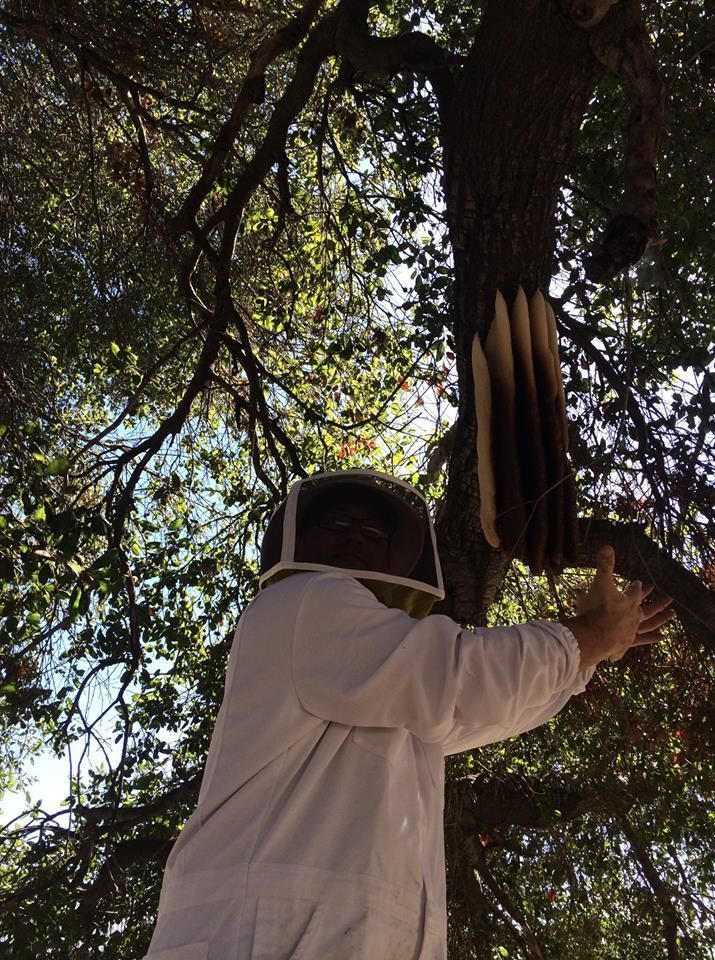
Low branches and dense hedges hold the classic softball to basketball cluster. The limb is supported, the mass is guided into a box in one motion, and remaining flyers are given time to follow the queen's scent inside.
Fence, Post, and Mailbox Swarms
Flat surfaces make a cluster spread out rather than hang, which changes the approach entirely. Bees are worked off the surface in sections, and the spot is then cleaned thoroughly so lingering pheromone stops advertising the place as a rest stop.
Vehicle and Equipment Swarms
Wheel wells, bumpers, motorcycle seats, and mower decks all attract clusters that leave owners stranded in their own driveway. Removal happens without solvents or sprays anywhere near paintwork, and the vehicle stays exactly where it is rather than being towed.
High and Awkward Clusters
Second-story eaves, palm crowns, and utility poles all call for reach equipment and patience. Height changes the sequence rather than the outcome, and any cluster that cannot be boxed safely is handled by another method agreed with you beforehand.
School and Commercial Grounds
Playgrounds, patios, and loading areas need the space cleared, the perimeter held, and the work finished quickly. Staff receive plain guidance on keeping people back while the cluster is collected and the surrounding buildings are checked for entry points.
Entry Point Inspection Afterward
A swarm in the yard usually means scouts have already toured the house from top to bottom. The roofline, attic vents, meter boxes, and eave gaps all get looked over, so the cluster's next choice is not your ceiling.
Lorem ipsum dolor sit amet, consectetur adipiscing elit.
Title 3
Why Choose Us for Bee Swarm Removal
Fast Windows on Short Notice
Swarms move on their own schedule and never on yours. Same-day availability exists on most weekdays precisely because a cluster spotted on Tuesday morning is frequently already gone by Wednesday afternoon, or worse, settled somewhere inside a wall.
The Whole Cluster, Not Most of It
Leaving a handful of bees behind leaves the queen's scent behind too, and the stragglers regroup within hours. Collection carries on until the mass is boxed and the remaining flyers have settled, which is slower and considerably more effective.
Calm Handling Around Bystanders
Neighbors gather, children watch from windows, and dogs bark at exactly the wrong moment. Working steadily rather than dramatically keeps a curious audience safe and stops a perfectly docile cluster from turning defensive halfway through the collection job.
The Property Checked for Their Next Move
A capture that ignores the building solves only half the problem. Looking over the likely cavities afterward is what stops a second swarm from arriving three weeks later and moving straight into an eave or a shed roof.
A Live Outcome Wherever It Fits
Swarms make the best relocation candidates of all, since they carry no comb or brood to disturb during the move. Where behavior allows it, the cluster goes into managed equipment and starts over somewhere it is genuinely wanted.
No Chemical Fog Over Your Garden
Boxing a cluster rarely calls for any treatment at all. Vegetable beds, fruit trees, koi ponds, and pet runs all stay completely untouched, which matters far more to most households than any speed a spray can might promise.
What Our Client Says
Hear from our Escondido, CA clients about their experience with Bee Free Bee Removal and our reliable pest control services. We’re committed to providing safe, effective, and professional solutions.
A Yard That Belongs to Your Family Again
Nobody enjoys explaining to a six-year-old why the trampoline is off limits. A clustered swarm is a temporary visitor that becomes a permanent tenant the moment scouts settle on a cavity nearby, so the sensible response is prompt rather than dramatic. Handled early, the whole thing is a short appointment, the bees usually get a second start at a managed site, and the roofline gets a look over while we are there. Bee Free Bee Removal keeps room in the schedule for exactly these calls around Escondido, CA because they will not wait. Describe what you are seeing on our contact page and we will get you a time.
FAQ's
How do I tell a swarm from an established nest?
A swarm is a dense hanging cluster of bees with no visible wax anywhere. An established nest shows comb, steady two-way traffic through one fixed opening, and bees disappearing into a structure rather than clinging to the outside of it.
How long will a cluster stay before moving on?
Usually one to three days. Scouts search the whole time, which is why Bee Free Bee Removal keeps same-day slots open around Escondido, CA after 17 years of these calls. The risk is where the colony settles next.
Is it dangerous to walk past a resting swarm?
Give it a wide berth and it will generally ignore you completely. Trouble starts with vibration, sprays, thrown objects, or somebody standing directly in the flight path, and defensive reactions escalate quickly with the Africanized bees common here.
Can a swarm be collected from high in a tree?
Often, using extension equipment or a bucket, depending on the branch and on what happens to sit underneath it. Palm crowns and power line clearances sometimes rule capture out, in which case the alternative is discussed with you first.
What happens if a swarm is simply left alone?
One of two things happens. It relocates within days to somewhere you cannot see, or it moves into your structure, which is when Bee Free Bee Removal gets called back out across Escondido, CA for a full cutout with repairs attached.
Why did a swarm land on my car or bicycle?
Warm metal, a resting queen, and the rest of the colony following her scent to the same place. Vehicles are just convenient furniture to a traveling swarm, and there is nothing about yours in particular that attracted them.
Do swarms return to the same tree every spring?
Sometimes they do, because pheromone traces linger on a favored branch and passing scouts recognize a proven staging spot. Cleaning that surface thoroughly after collection reduces the chance of a repeat performance in your yard the following season.
What should I avoid doing while waiting for help to arrive?
Skip the garden hose, the wasp spray, and the smoky fire. All three agitate a calm cluster without dispersing it, and they can turn a straightforward capture into a defensive incident in the middle of your own front yard.