
Bees in Eaves Removal in Escondido, CA
Clear the Roofline and Close the Gap
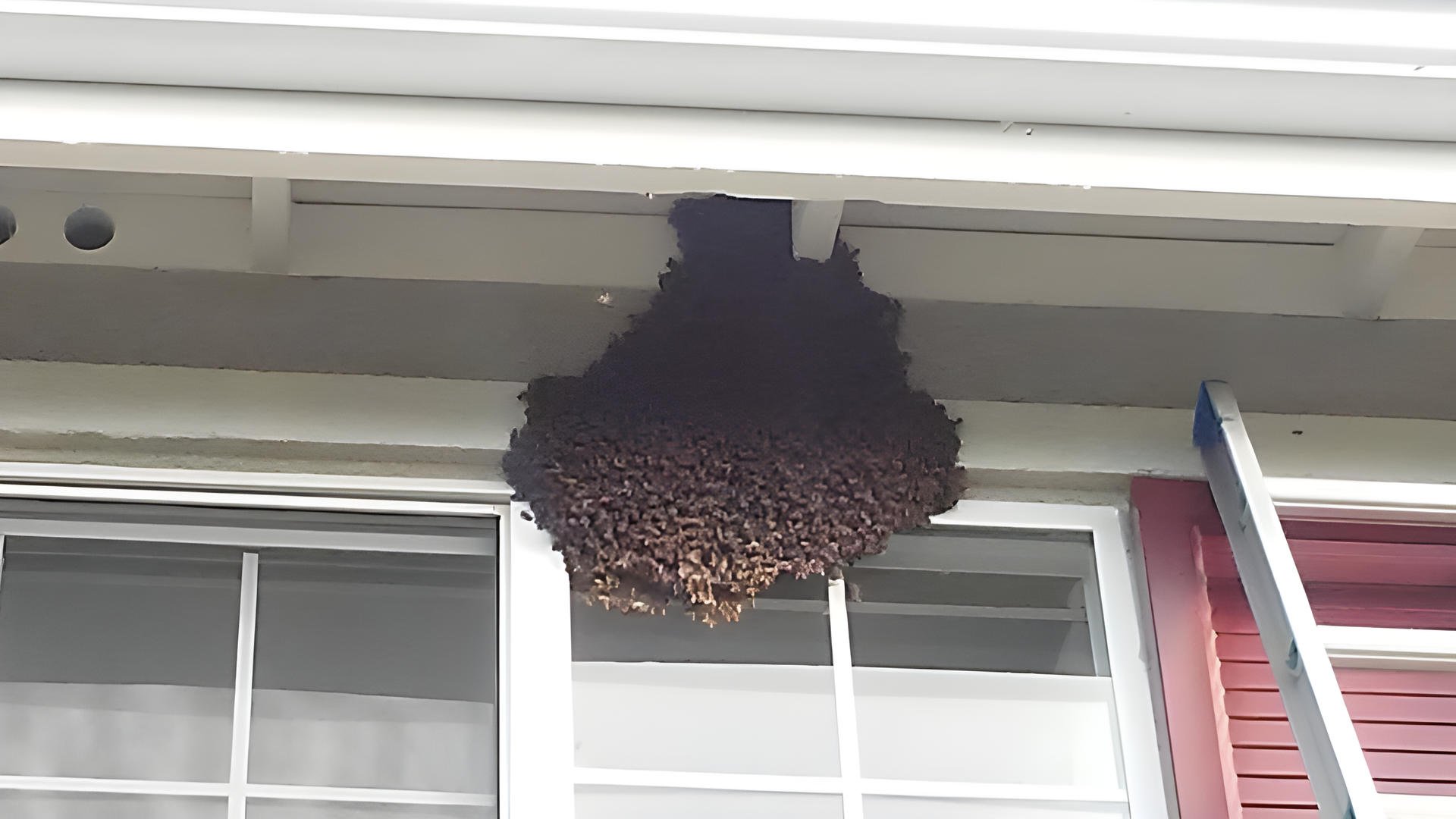
A honey bee colony can move into a roofline through an opening no wider than a quarter inch, which explains why eave vents, fascia seams, and stucco weep screeds account for so many of these calls every spring. Bee Free Bee Removal works those heights across Escondido, CA, and out through Carlsbad, Oceanside, Vista, Encinitas, and San Marcos, reaching the nests tucked between soffit boards, rafter tails, and the tile roof edge sitting just above them.
Eave colonies get missed for months at a time because the traffic sits above eye level and the humming stays faint indoors. By the time honey starts marking the ceiling, the nest has usually spread along an entire joist bay. We open up the soffit, clear the cavity, and then close every gap the roofline offers. 17 years of ladder work informs how all of that is sequenced. Book an inspection through our contact page.
Bees in Eaves Removal We Carry Out
Soffit and Fascia Colony Removal
Panels come down along their fastening lines rather than being torn off, so they can go back looking original. The nest behind them is removed whole, and the cavity is scraped and cleaned out before anything is refastened into place.
Rafter Tail and Bird Block Nests
The gaps between rafter tails are exactly the volume a swarm looks for. Each bay gets opened, cleared, and checked individually, because a colony that starts in one bay very commonly expands sideways into the two bays beside it.
Tile Roof Edge and Bird Stop Gaps
Missing or broken bird stop along a tile roof edge leaves a row of open cavities under the first course. Nests there are removed from the edge, and the gaps are properly closed so the whole row stops being available.
Attic Vent and Gable Entry Points
Torn screens on gable and eave vents let a colony pass straight from the roofline into the attic itself. Vents are inspected, cleared of any nest material, and then rescreened with mesh that will not simply tear again next season.
Two-Story Access and Fall Protection
Upper rooflines demand platforms, stabilizers, and anchored equipment rather than improvisation. Setting that up properly takes time at the start of a job, and it is the reason difficult heights still get finished in one visit instead of two.
Eave Exclusion and Screening
Once the cavity is empty, every remaining gap along that elevation gets sealed or screened. Weep screeds, pipe penetrations, and lighting cutouts all get attention too, since closing one entrance while leaving five others open achieves very little.
Lorem ipsum dolor sit amet, consectetur adipiscing elit.
Title 3
Why Choose Us for Bees in Eaves Removal
Height Treated as Routine, Not Heroic
Most of this work happens between 12 and 25 feet up, which is precisely where corners get cut. Arriving with the right access equipment means the job is decided by the nest rather than by how far a ladder reaches.
Entry Points Found Rather Than Guessed
Bees frequently enter at one point and nest several feet away along the bay. Watching traffic, checking both sides of the fascia, and probing the cavity prevent an opening being cut in a spot the colony never occupied.
Panels Reopened and Reset Neatly
Soffit material is not cheap and rarely matches once it has been damaged. Removing panels along their fixings, keeping them intact, and refastening them properly is what separates a tidy repair from an obvious scar running along your roofline.
The Attic Checked Behind the Eave
An eave colony that found a vent screen has often pushed farther inside than anyone realizes. Looking into the attic space directly behind the nest confirms whether the problem stops at the soffit or carries on into the insulation.
Screening Built for Outdoor Life
Plastic mesh and foam both fail within a season under coastal sun. Metal screening, proper sealant, and correctly sized closures are what keep an exclusion working for years, rather than reopening the moment that material starts breaking down.
Scheduling That Suits the Structure
Eave work needs clear access, dry conditions, and reasonably calm wind. Booking realistically around those factors is why our appointments hold, instead of us arriving on the day, looking up at a windy two-story elevation, and rescheduling on the spot.
What Our Client Says
Hear from our Escondido, CA clients about their experience with Bee Free Bee Removal and our reliable pest control services. We’re committed to providing safe, effective, and professional solutions.
A Roofline That Stays Quiet Through Spring
Eaves are the most commonly chosen part of a house for good reason. They are shaded, sheltered, full of ready-made cavities, and almost never inspected by anyone. That combination means a colony can settle in above the front door in March and go unnoticed until honey starts marking the ceiling in July. Clearing the nest and then closing every gap along that elevation is what turns a recurring seasonal problem into a finished one, and it is the standard Bee Free Bee Removal works to across Escondido, CA. If you have watched bees disappearing under the roof edge, start with our contact page.
FAQ's
How small an opening can bees use to reach an eave?
Roughly a quarter inch is enough for the workers to pass through comfortably. That is narrower than most people picture, which is why the gaps at weep screeds, vent corners, and fascia joints get overlooked during ordinary maintenance.
Why do bees prefer eaves over other parts of a house?
Shade, shelter, and ready-made cavities in one place. The space between rafter tails offers the right volume, a small defensible entrance, and protection from rain and heat, which is close to the ideal a scout is searching for.
Can bees in the eave get into the attic or living space?
They can if a vent screen has failed or a gap opens into the framing. Most eave colonies stay in the soffit cavity, though checking the attic behind the nest is the only way to be sure of that.
Does the soffit have to be cut open to reach them?
In nearly every case, either by removing panels or by cutting a modest access opening. There is no reliable way to extract comb from a closed cavity, and treatment on its own leaves the nest material in place.
What is bird stop, and why do bees end up using it?
Bird stop is the filler closing the gap under the first course of roof tiles. Where it is broken, missing, or was never installed at all, it leaves a neat row of sheltered cavities that passing swarms find quickly.
Will screening the vents keep bees out permanently?
Screening handles the vents, which is only part of the elevation. Bee Free Bee Removal seals weep screeds, fascia joints, pipe penetrations, and light fixtures across Escondido, CA too, so that no single overlooked gap undoes all the rest.
How do you work safely on a two-story eave?
With stabilized ladders, platforms, and anchored equipment all set up before any bee work begins. Height and defensive insects make a poor combination, so the access arrangement is settled first and never improvised partway through a removal job.
Do tile roofs see more bee problems than shingle roofs?
They tend to, mostly because of the cavities under the tile edge and behind failed bird stop. In 17 years Bee Free Bee Removal has cleared far more nests along tile roof edges around Escondido, CA than on shingle rooflines.